
How to Do a Wisconsin Title Search for Free (2026 Guide)
If you’re buying property in Wisconsin, the first thing you need to confirm is whether the title is clean. A title search reveals who legally owns a property, whether any mortgages remain open, and whether any liens or judgments are attached to it. The good news: Wisconsin makes this possible for free through each county’s Register of Deeds office — no title company required for a basic search.

This guide walks through how the process works, what you’ll actually find, and where to search in Kenosha, Racine, and Ozaukee counties — plus links to the statewide directory.
What Is a Wisconsin Title Search?
A title search is an examination of public records to confirm the legal ownership of a property and identify anything attached to that title — mortgages, liens, easements, court judgments, or restrictions. In Wisconsin, these records are maintained at the county level by the Register of Deeds office.
Wisconsin is a marital property state, which means property acquired during a marriage is presumed to be jointly owned by both spouses. A deed that doesn’t properly reflect marital property status can create a title issue later. This is one reason title searches in Wisconsin require attention to how names are vested on the deed, not just who paid for the property.
The most common title product used in Wisconsin is the Owner & Encumbrance (O&E) Report, which covers up to 30 years of title history sourced from the Register of Deeds and confirms current ownership, open mortgages, recorded liens, judgments, federal tax liens, and easements or restrictions on record.
What a Title Search Checks
- Current legal owner (vested deed)
- Chain of title — every recorded transfer going back 30+ years
- Open mortgages and refinances
- Judgment liens and federal tax liens
- Mechanic’s liens and special assessments
- Easements, covenants, and deed restrictions
- Marital property status on the deed
Free Title Search vs. Paid Abstract: What’s the Difference?
You can search Wisconsin property records for free through county portals — this gives you ownership details, recorded documents, and tax information. What you cannot get for free is a certified abstract prepared by a licensed title examiner, which organizes all findings into a formal report with copies of referenced documents.
Document copies from the Register of Deeds office typically run $1–$2 per page. Viewing records online costs nothing.
| Feature | Free County Portal | Paid Title Abstract |
|---|---|---|
| Owner name & deed | ✅ Yes | ✅ Yes |
| Parcel number & legal description | ✅ Yes | ✅ Yes |
| Recorded documents (deeds, mortgages) | ✅ Viewable | ✅ Copies included |
| Lien & judgment search | ⚠️ Partial (some counties) | ✅ Full cross-reference |
| Chain of title (30 years) | ⚠️ Manual research needed | ✅ Compiled by examiner |
| Certified for closing or lender | ❌ No | ✅ Yes |
| Cost | Free (copies $1–$2/page) | $35–$250+ |
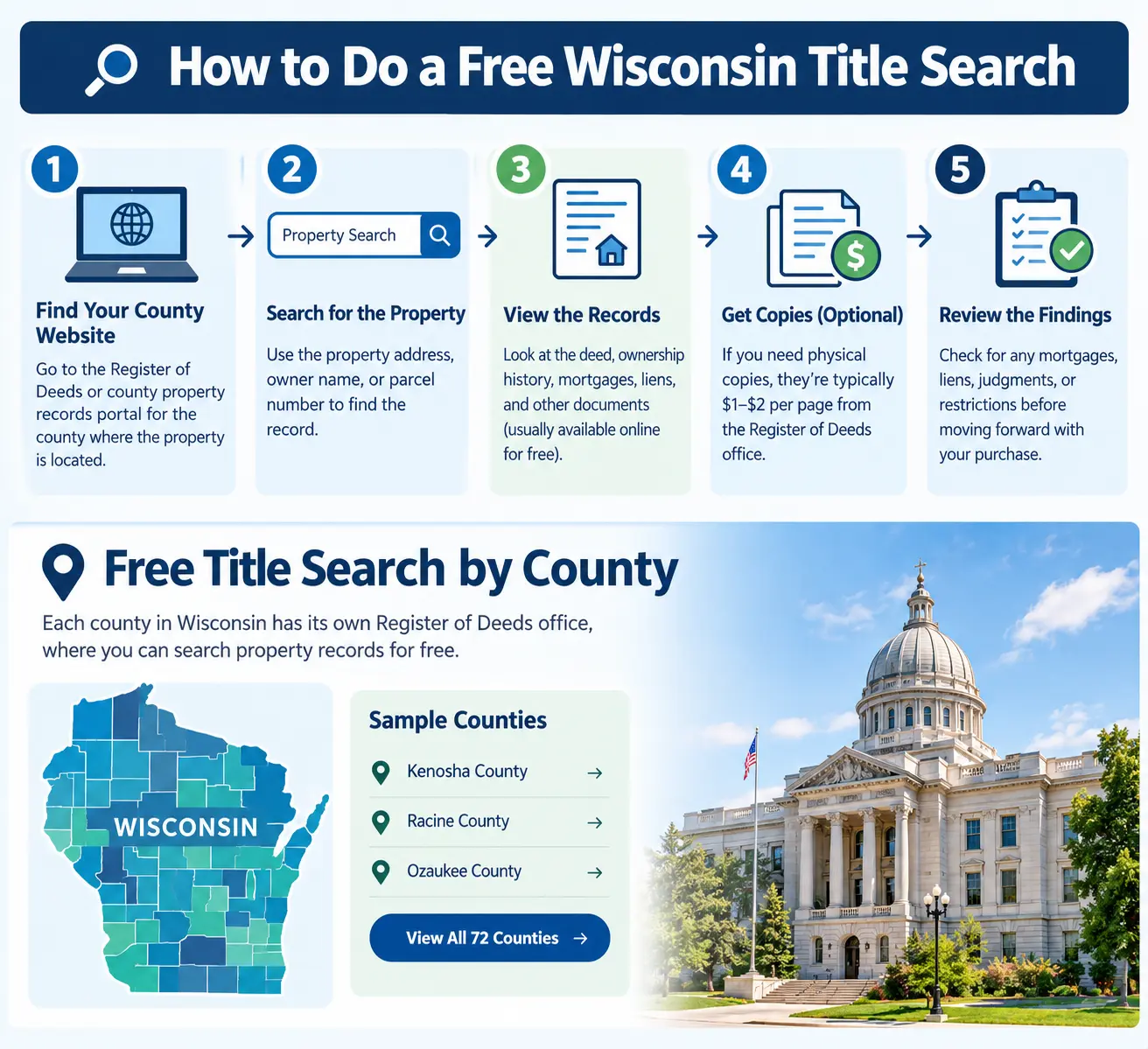
How to Do a Free Wisconsin Title Search (Step by Step)
Follow these steps using the county’s Register of Deeds portal — no account or payment required for basic searches.
Free Title Search by County: Kenosha, Racine & Ozaukee
Kenosha County Title Search
Kenosha County maintains a free online Property Inquiry portal that allows searches by owner name, property address, or parcel identification number. The portal provides access to ownership details, tax assessments, and recorded documents through the county land records system. Kenosha County has 68,358 parcels on record, with zoning classifications standardized across 68,275 of those parcels.
For recorded real estate documents — deeds, mortgages, liens, and land contracts — you can access the Register of Deeds office in person at the Kenosha County Administration Building, or use the county’s online document search system. The office is open Monday through Friday, 8 a.m. to 4:30 p.m. Recording fee is $30 per document regardless of page count; transfer fee is $3 per $1,000 of value.
Racine County Title Search
Racine County’s Register of Deeds is located at 730 Wisconsin Avenue, Racine, WI 53403, operating Monday through Friday, 8 a.m. to 4:30 p.m. The county’s TriMin Document Search application allows you to search for recorded documents by parcel and links directly to their LandShark document access system. Tax records are searchable by address, parcel number, or owner name. Racine County reports a median home value of $260,300 and a property tax rate of approximately 1.55% of assessed value.
Ozaukee County Title Search
Ozaukee County uses two systems for online real estate document access: Tapestry EON for occasional users, and Laredo Anywhere for title insurance firms and real estate professionals requiring daily access. Both are fee-based for document retrieval. For free parcel-level information, the Ozaukee Geo Hub interactive map provides free public access to parcel data. Ozaukee County has 41,165 parcels, with an effective property tax rate of approximately 1%.
Wisconsin Title Search: All 72 Counties
Every Wisconsin county maintains its own Register of Deeds office with free public access to property records. The Wisconsin Register of Deeds Association directory at wrdaonline.org lists contact information for all 72 counties. For parcel-level searches, use our free county search tool below.
For a complete list of county-level property search tools, see our guide on how to search county records online across Wisconsin.
Common Title Problems Found in Wisconsin Searches
- Open mortgage with no satisfaction: A mortgage recorded but never released — the lender’s lien may still be valid even if the debt was paid informally.
- Marital property issues: A deed signed by only one spouse when both should have signed, creating a potential ownership claim from the non-signing spouse.
- Judgment liens: Court judgments against the owner that attach to all real estate they own in that county.
- Gaps in chain of title: Missing conveyances that leave ownership history incomplete — common with older properties or estates.
- Easements not visible from the street: Recorded utility or access easements that restrict what the owner can build or do on the land.
- Federal tax liens: IRS liens that attach to all property owned by the debtor — require searching the IRS lien registry in addition to county records.
When a Free Search Isn’t Enough
A free county portal search works well for basic due diligence — confirming current ownership, finding the parcel number, or checking whether recent documents have been filed. For any purchase transaction, mortgage closing, or legal dispute, you need a certified title search prepared by a licensed abstractor or a title insurance commitment from a title company.
Wisconsin title abstracts must be prepared by a professional title researcher — they are not available from public county records and cannot be downloaded electronically. If you need a certified deed copy or want to look up the current owner on an unfamiliar parcel, those guides walk through each process separately.
Frequently Asked Questions
Can I do a Wisconsin title search for free?
Yes. You can search Wisconsin property records for free through each county’s Register of Deeds online portal. This lets you view ownership details, parcel information, and recorded documents at no cost. Physical copies of documents cost $1–$2 per page. A certified title abstract prepared by a professional abstractor is a separate, paid product.
How far back does a Wisconsin title search go?
Professional title searches in Wisconsin typically cover 30 years of ownership history. This is the standard used for an Owner & Encumbrance (O&E) Report. A full chain-of-title abstract may go further back depending on the property’s history and what the transaction requires.
Where do I search for judgment liens in Wisconsin?
Judgment liens are searchable through the Wisconsin Circuit Court Access (WCCA) portal at wcca.wicourts.gov. Liens become enforceable against real estate when also recorded with the county Register of Deeds. Always check both sources for a complete lien search.
Is Wisconsin a marital property state for title purposes?
Yes. Under the Wisconsin Marital Property Act, property acquired during marriage is generally presumed to be jointly owned by both spouses. A deed that doesn’t properly reflect marital property status can create a title defect that needs to be resolved before the property can be cleanly conveyed.
What’s the difference between a title search and title insurance?
A title search examines existing public records to identify problems with the title. Title insurance protects against losses from defects not found during the search, or that arose before your ownership. Lenders typically require a lender’s title insurance policy at closing; a buyer’s (owner’s) policy is optional but recommended.