You don’t need to pay $30 to a people-search website to find out who owns a property in Wisconsin. The state makes property ownership records publicly available it’s the law and most of the best lookup tools are completely free to use.
Whether you’re eyeing an abandoned house on your street, trying to reach a neighbor about a shared fence issue, or doing due diligence before making an offer on a property, you can get an owner’s name and mailing address in under five minutes using the right tool.
This guide walks you through every legitimate free method, in order of reliability. By the end, you’ll know exactly which tool to use for your specific situation including the one step most people skip when a property is owned by an LLC.
Quick Answer: The fastest free way to find a property owner in Wisconsin is to search your county’s online assessor or treasurer database by address. Enter the property address, and the record will show the owner’s name, their mailing address, the assessed value, and tax history. If you don’t know the county, use the Wisconsin Department of Revenue’s statewide property lookup tool instead.
Who Actually Needs This — and Why It Works
Before jumping into the how-to, it helps to know why this works at all.
In Wisconsin, property ownership is a matter of public record under Wisconsin Statute 19.31–19.39, commonly known as the Wisconsin Open Records Law. When someone buys property, the deed gets recorded at the county Register of Deeds office, and that information becomes accessible to anyone. The county assessor then uses that recorded deed to maintain a current owner database for property tax purposes.
This means you’re not hacking into anything or using gray-market tools when you look up who owns a property. You’re accessing government records that exist specifically to be public.
People who regularly use these methods include:
- Real estate investors researching off-market properties or vacant lots they want to purchase
- Homeowners trying to contact the owner of a neighboring eyesore or overgrown vacant lot
- Attorneys and title researchers tracing the chain of ownership before a real estate transaction
- Journalists and advocates investigating code violations or slumlord-owned rental properties
- Estate researchers trying to find heirs of a deceased property owner
Now, here’s how to actually do it.
Method 1: Wisconsin County Assessor Records (Best Starting Point)
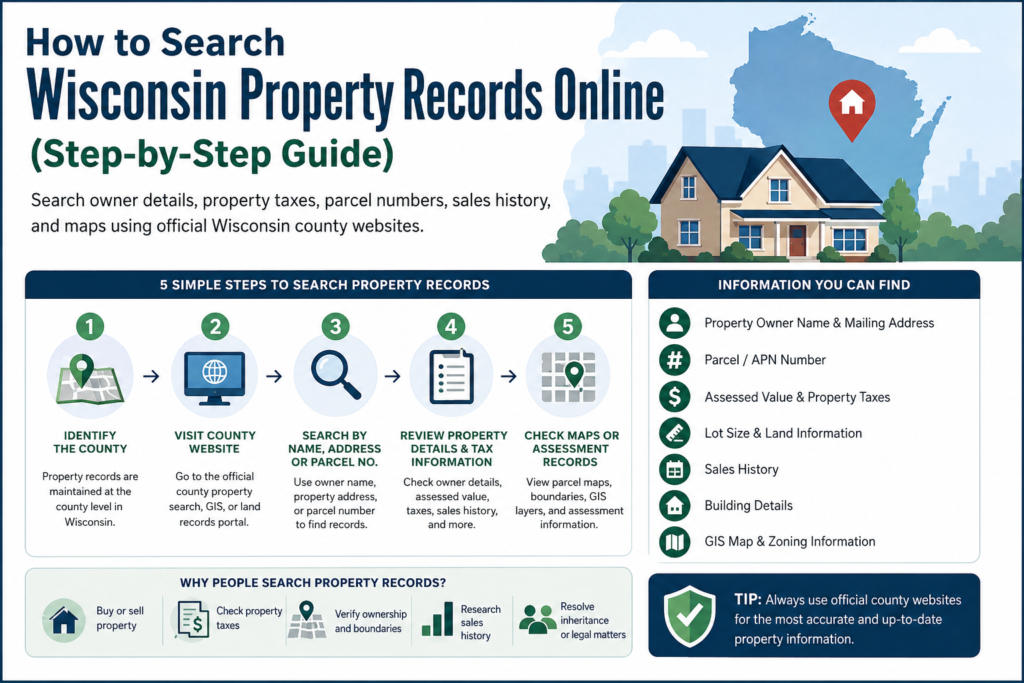
This is the method you should try first. Every county in Wisconsin maintains an online searchable database of all taxable properties in the county, including the current owner’s name and their mailing address (which is often different from the property address if they’re a landlord or out-of-state owner).
How to Search the County Assessor Database
Step 1: Figure out which county the property is in. If you know the city or town name, a quick Google search like “what county is [city name] in Wisconsin” will confirm it.
Step 2: Search for “[County name] county WI property search” or “[County name] county assessor property lookup.” Almost every Wisconsin county now has a free online portal.
Step 3: On the county portal, search by property address. You don’t need a parcel number, though having one makes the search faster.
Step 4: The result will show you the owner’s name, their mailing address, the parcel ID, property description, assessed value, and often a full sale history.
Direct Links for Wisconsin’s Largest Counties
Rather than searching around, here are direct links for the most-searched counties:
- Milwaukee County: Milwaukee County tax records are searchable through the City of Milwaukee’s MPROP database for city properties, and through individual municipality portals for suburban properties like Wauwatosa, West Allis, and Greenfield. Search “[municipality name] WI property lookup” for each.
- Dane County (Madison): The Dane County Land Records portal at accessdane.countyofdane.com lets you search by address across the entire county.
- Waukesha County: Waukesha County’s Land Information system at waukeshacounty.gov provides full parcel search with owner details.
- Brown County (Green Bay): Brown County’s assessor records are searchable at brownco.org/landrecords.
- Racine County: Racine County property records are available at co.racine.wi.us through their property search module.
What You’ll See in the Record
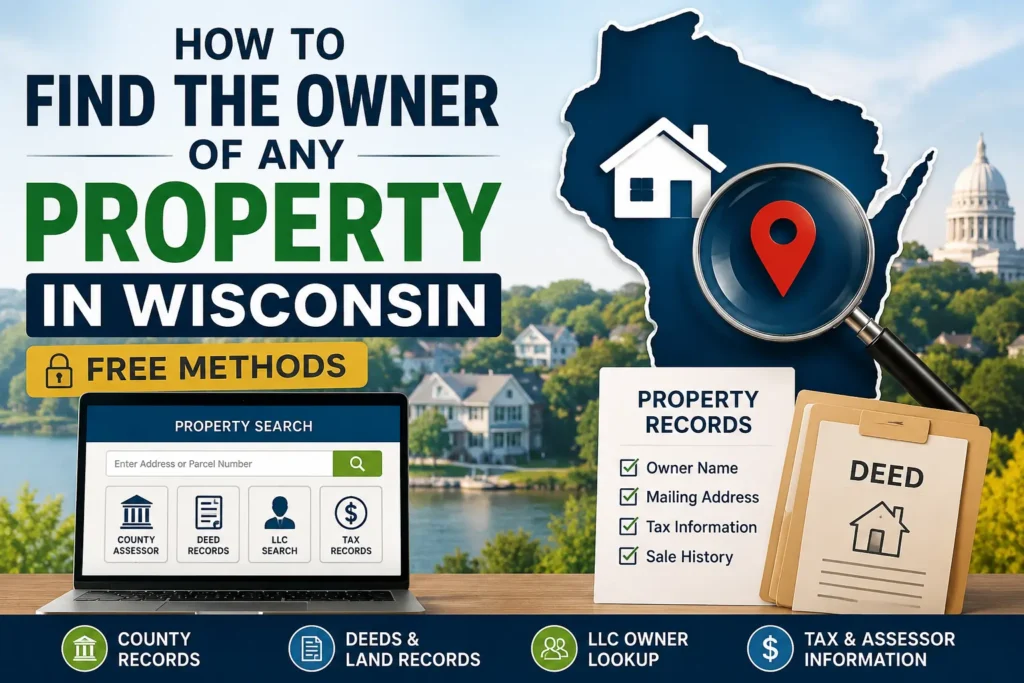
A typical county assessor record includes:
- Owner name (individual name, LLC name, trust name, etc.)
- Owner mailing address — this is where they receive tax bills, so it’s usually current
- Property address and legal description
- Assessed value and taxable value
- Tax status — whether taxes are current or delinquent
- Sale date and sale price for recent transactions
- Parcel ID number — useful if you need to search other systems
This is enough information to write a letter, make a call or identify the owner’s entity type for further research.
Method 2: Wisconsin Register of Deeds (For Full Ownership History)
While the assessor tells you who owns a property right now, the Register of Deeds tells you every owner the property has ever had, plus any liens, mortgages, or easements attached to it.
Every Wisconsin county has a Register of Deeds office that records legal documents related to real property. These include warranty deeds, quit claim deeds, land contracts, mortgages, satisfaction of mortgages, and lis pendens filings.
When to Use This Instead of the Assessor
Use the Register of Deeds when you need:
- The full chain of title going back decades
- To see if there are any active liens or judgments on the property
- The actual deed document (not just the tax record) showing how ownership was transferred
- To verify the legal description of the property
For most people trying to find a current owner and contact them, the assessor database is faster and easier. The Register of Deeds becomes essential when you’re doing a more thorough investigation for example, if you’re trying to buy a property and want to confirm the seller actually has clean title.
How to Access Deed Records Online
Wisconsin’s Land Information Program (WLIP) supports online access to deed records across many counties. Some counties offer this through their own portals; others use shared systems like LandShark or CSC eRecording.
To find deed records:
- Go to your county’s Register of Deeds website (search “[County name] WI register of deeds”)
- Search by grantor/grantee name or by parcel number
- Download the recorded document as a PDF
A handful of rural counties still require an in-person visit for older deed records, but most of the state’s major counties have full online access.
Method 3: Wisconsin Department of Revenue Statewide Search
If you’re not sure which county a property is in, or you want a quick statewide search without going county-by-county, the Wisconsin Department of Revenue maintains a searchable property assessment database.
The DOR’s Property Assessment Data tool is available at revenue.wi.gov under the “Property” section. It pulls data from counties participating in the state’s uniform assessment system.
How to Use It
- Go to the WI DOR property search page
- Select your search type: address, municipality, or parcel ID
- Enter the property address
- The result shows the owner name, mailing address, municipality, assessed value, and a link to the county assessor record for more detail
One Important Limitation
Milwaukee County is the notable exception it uses its own separate assessment system and its data isn’t fully integrated into the state DOR portal. If you’re searching a Milwaukee County property, go directly to the individual municipality’s lookup tool rather than the statewide DOR search.
Method 4: Finding Owners of LLC-Owned Properties (The Step Most People Skip)
This is where most free property searches break down and where most guides stop short.
In Wisconsin, a significant number of properties (especially rentals, commercial buildings, and investment properties) are held in the name of an LLC rather than an individual. When you pull the county assessor record and see “1234 Oak Street LLC” or “Badger State Holdings LLC” as the owner, you haven’t found a real person yet.
Here’s how to get from the LLC name to an actual human contact.
Step 1: Search the Wisconsin DFI Business Database
The Wisconsin Department of Financial Institutions maintains a free, searchable database of all businesses registered in the state. Go to wdfi.org and use the “Business Search” tool.
Search by the LLC name exactly as it appears in the property record. The result will show you:
- The LLC’s registered agent name and address
- The principal office address
- The names of any officers or members (if listed in their annual reports)
- Whether the LLC is in good standing or has been dissolved
The registered agent is the person or company designated to receive legal mail on behalf of the LLC. This is often either the owner themselves or an attorney. Either way, it gives you a real mailing address to reach out to.
Step 2: If the LLC Is Dissolved
A dissolved LLC means the business has been formally closed. The property may still be in their name, but the owner isn’t actively managing it. In this case, go back to the Register of Deeds and look at the deed it will name the person who signed on behalf of the LLC when the property was purchased. That person is likely still connected to the property.
Step 3: If It’s a Trust
Properties held in a revocable living trust (e.g., “John Smith Living Trust”) are typically still tied to an individual. The trustee name is often listed in the deed itself. Pull the deed from the Register of Deeds and look at who signed as grantor or trustee.
Method 5: Zillow, Redfin, and Other Public Listing Tools
For properties that are currently for sale or were recently sold, real estate portals like Zillow, Redfin, and Realtor.com surface some useful information though they won’t directly show you the current owner’s name.
What they will show you:
- Sale history — previous sale prices and dates, which you can cross-reference with deed records
- Current listing agent — if the property is listed for sale, the agent can often facilitate contact with the seller
- Owner-claimed profiles — some Zillow listings include the owner’s claimed profile if they’ve listed it themselves
These tools are most useful as a cross-reference, not a primary search. If you find a sale date on Zillow, use it to pull the specific deed from the Register of Deeds that deed will show who transferred ownership to the current owner, which is a useful confirmation step.
How to Find the Owner of a Vacant or Abandoned Property in Wisconsin
Vacant and abandoned properties are the hardest cases because the owner is often unresponsive, out-of-state, or behind on taxes. Here’s a specific approach for these situations.
Check for Tax Delinquency First
Most Wisconsin counties publish annual delinquent tax lists as public records. A property that’s significantly behind on taxes is a signal that the owner is either unreachable, financially distressed, or simply absentee.
To find the delinquent tax list:
- Search “[County name] WI delinquent property tax list”
- Most counties publish this as a PDF or searchable table often in the local newspaper as required by law, and on the county treasurer’s website
If the property appears on the delinquent list, note the years of delinquency. In Wisconsin, the county can begin foreclosure proceedings after two years of delinquency. If the property is close to that threshold, time may be short if you want to contact the owner before the county takes it.
Contact the Municipality Directly
Wisconsin cities, villages, and townships often maintain their own lists of problem properties homes with open code violations, properties under nuisance orders, or buildings that have been condemned. The city clerk, code enforcement office, or housing department may have contact information for the property owner that isn’t in the public assessor database.
This is especially true in larger cities like Milwaukee, Madison, Green Bay, and Racine, which have dedicated housing code enforcement divisions. A phone call to the city clerk’s office explaining that you’re trying to reach the property owner is often surprisingly productive.
Use Wisconsin’s Unclaimed Property Database
If the owner has passed away and the property is in limbo, check the Wisconsin Department of Revenue’s unclaimed property search at revenue.wi.gov. While this doesn’t list properties directly, it can help you identify if financial accounts or insurance proceeds related to the estate are sitting unclaimed which may help you locate heirs or an estate executor.
What to Do After You Find the Owner
Finding the owner is step one. What you do next depends on why you were searching.
If You Want to Buy the Property
The most effective approach is a simple, direct letter sent to the owner’s mailing address. Keep it short: you’re interested in purchasing their property at [address], you’re a serious buyer, and you’d like to have a conversation. Include your phone number and email.
Hand-written or typed on personal letterhead tends to get better response rates than anything that looks like a form letter. If you’re an investor sending volume mail, use a handwritten font at minimum.
Don’t lead with price in the first letter. The goal is a response, not an accepted offer. Once they respond, you can have a real conversation.
If You Want to Report a Code Issue
Contact your local municipality’s code enforcement office with the owner’s name and mailing address. They may already have an open case on the property, and your information adds to the record.
If All Free Methods Fail
Sometimes the owner is genuinely hard to find they’ve moved multiple times, they’re using a registered agent that just forwards mail to a PO box, or the LLC has been through multiple registered agents.
In these cases, professional skip tracing services like BatchLeads, TLOxp, or CLEAR by Thomson Reuters can find current contact information by cross-referencing multiple data sources including credit headers, utility records, and change-of-address data. These services charge a per-search fee, but they’re significantly cheaper than what you’d pay a private investigator.
Is It Legal to Look Up Property Owner Information in Wisconsin?
Yes completely. Wisconsin’s Open Records Law (Wis. Stat. § 19.31–19.39) establishes a strong presumption in favor of public access to government records. Property ownership records, tax records, and recorded deeds are all government records, which means they are public by default.
You don’t need to state a reason for requesting them. You don’t need to be a Wisconsin resident. You don’t need to be involved in any legal proceeding. Any person can access these records.
What you cannot legally do with the information you find:
- Use it for stalking or harassment (this is a criminal offense under Wisconsin law regardless of how you obtained the information)
- Use it to make credit, insurance, or employment decisions those uses are governed by the Fair Credit Reporting Act and require specific compliance steps that these government databases don’t meet
- Represent yourself as having legal authority you don’t have when contacting an owner (i.e., don’t pretend to be a government official)
Beyond those limits, looking up public property records is a routine, legal activity that real estate professionals, attorneys, journalists, and ordinary property owners do every day.
Quick Comparison: Which Free Method Should You Use?
| Method | Best For | Speed | Works Statewide? | Difficulty |
|---|---|---|---|---|
| County Assessor Database | Current owner + mailing address | Very fast (2–3 min) | Yes (county by county) | Easy |
| WI DOR Property Search | Quick statewide lookup by address | Fast (under 5 min) | Most counties (not Milwaukee) | Easy |
| Register of Deeds | Full ownership history, liens, deeds | Moderate (5–15 min) | Yes (county by county) | Moderate |
| WI DFI Business Search | LLC-owned properties | Fast once you have LLC name | Yes, statewide | Easy once you know the step |
| Municipality/Code Enforcement | Vacant/abandoned properties | Varies | No (city by city) | Moderate |
| Zillow / Real estate portals | Recently sold or listed properties | Fast | Yes | Easy |
The bottom line: For most lookups, start with the county assessor database. If the owner is an LLC, immediately follow with the Wisconsin DFI business search. If the property is vacant and the owner is unresponsive, add the delinquent tax list and municipality contact. These three steps together will get you actionable owner information in the vast majority of cases for free.
The easiest way to find a property owner in Wisconsin is through the county assessor’s database. If the property is owned by an LLC, use the Wisconsin DFI business search to identify the registered agent. For ownership history, deed records from the Register of Deeds provide the most complete information.
Frequently Asked Questions
How do I find the owner of a property by address in Wisconsin?
Go to your county’s assessor or land records portal and search by the property’s street address. The record will return the owner’s name and their mailing address. If you don’t know the county, use the Wisconsin DOR’s statewide property assessment search at revenue.wi.gov.
Are Wisconsin property records public?
Yes. Wisconsin’s Open Records Law (Wis. Stat. § 19.31–19.39) makes property ownership records, tax records, and recorded deeds public by default. Anyone can access them without stating a reason.
How do I find who owns a vacant lot in Wisconsin?
Search the county assessor database by address first. If the owner appears to be unreachable, pull the county’s delinquent tax list to check whether taxes are unpaid (a common indicator of an absentee owner), then contact the local municipality’s code enforcement office, which often has additional contact records.
What is a Wisconsin parcel number and how do I find it?
A parcel number (also called a parcel ID or tax key) is a unique identifier assigned to every piece of property in a county for assessment purposes. You’ll find it in the county assessor search results once you locate a property by address. It typically looks like a sequence of numbers separated by dashes or periods. Once you have it, you can use it to search deed records and other county databases more precisely.
Can I find property owner information for free without a paid service?
Yes. The county assessor database, Wisconsin DOR property search, Register of Deeds, and Wisconsin DFI business search are all free. Paid services like skip tracing tools are only necessary in the minority of cases where a property owner has moved recently and their public records haven’t caught up.
How do I find the owner of an LLC-owned property in Wisconsin?
If the county assessor record shows an LLC as the owner, search that LLC’s exact name in the Wisconsin Department of Financial Institutions (DFI) business database at wdfi.org. The search results will show the LLC’s registered agent name and address, which gives you a real person or law firm to contact on behalf of the property owner.