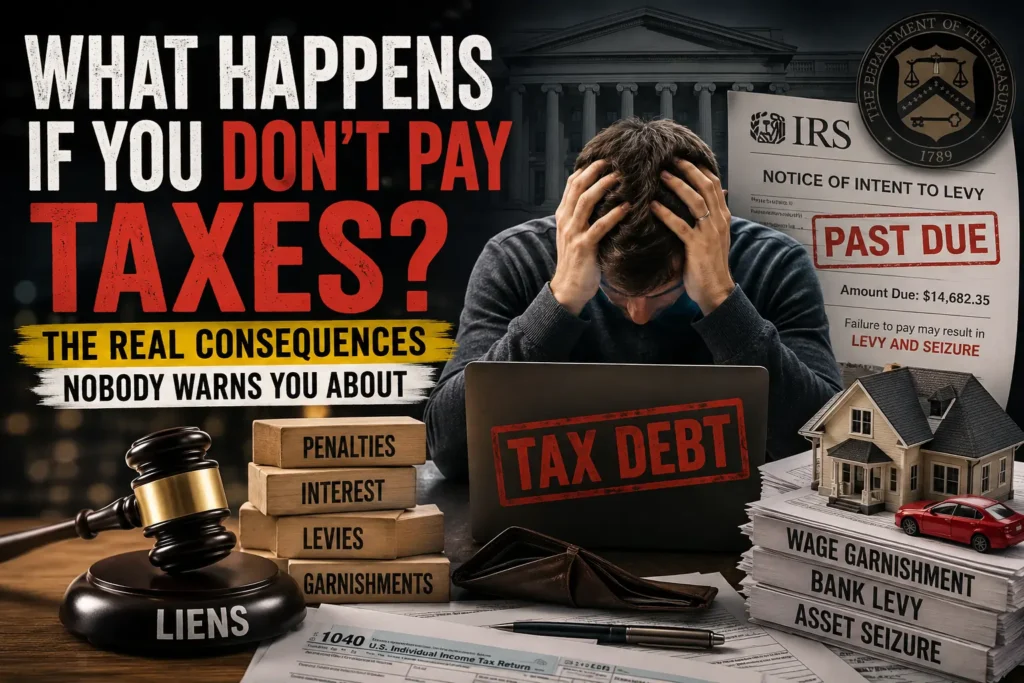
Most people know they’re supposed to pay taxes. But what actually happens if you don’t? A late payment? A strongly worded letter? The reality is far more serious and it escalates faster than most people expect.
Whether you’ve missed a deadline by accident, skipped filing altogether, or are quietly hoping the tax authority forgets about you this article lays out exactly what’s coming your way, step by step.
Quick Answer:
If you don’t pay taxes, the consequences usually start with penalties and interest, followed by collection notices, tax liens, wage garnishments, bank levies, and in serious cases criminal prosecution. Most cases remain civil matters, but deliberate tax evasion can lead to fines and imprisonment.
What Happens Immediately After You Miss a Tax Payment?
Interest and Penalties Start Growing
The first thing that happens when you don’t pay taxes on time is deceptively simple: your debt starts growing. Tax authorities don’t immediately send agents to your door. They start charging you interest on whatever you owe, sometimes daily.
In the United States, the IRS charges interest based on the federal short-term rate plus 3%. That might not sound alarming, but when compounded over months or years on a debt of several thousand dollars, it adds up fast. And interest isn’t the only thing piling on penalties hit you too.
There are two separate penalties you need to know about:
- Failure-to-file penalty: If you don’t file your return at all, this penalty is typically 5% of your unpaid taxes per month, up to 25% of the total.
- Failure-to-pay penalty: If you file but don’t actually pay, this is usually 0.5% per month lower, but it keeps running until you settle.
Here’s what catches people off guard: both penalties can run simultaneously. You can be hit with both at once, and the total can reach a significant percentage of your original tax bill before you’ve even received a formal notice.
Tax Notices and Collection Letters Explained
After a missed payment, the IRS (or your country’s tax authority) will begin sending notices. These aren’t just reminders they’re a formal escalation sequence.
In the US, a typical notice sequence looks like this:
- CP14 — Your first notice. It tells you what you owe, including any penalties and interest already accrued.
- CP501 / CP503 — Follow-up reminders if you ignore the first one.
- CP504 — This one is serious. It’s a “Notice of Intent to Levy,” meaning the government is warning you it can seize your assets.
- Letter 1058 / LT11 — This is your final warning before actual collection action begins.
Most people make the mistake of ignoring the early notices. By the time the final notice arrives, the debt is often significantly larger than it was at the start. Responding early even if you can’t pay in full puts you in a far better position than going silent.
Can the Government Seize Your Assets?
If you continue ignoring the notices, the tax authority can move into active collection. This is where things get genuinely disruptive to your life.
Tax Liens
A tax lien is a legal claim against your property. Once the government files a lien, it attaches to everything you own your home, your car, your business assets, and even future assets you acquire. A lien shows up in public records, which means:
- Lenders can see it, making it nearly impossible to get a loan or mortgage
- It can affect your ability to sell property
- Your credit score takes a serious hit
A lien doesn’t mean they’ve taken anything yet. It means the government has staked a legal claim first in line.
Tax Levies
A levy is the actual seizure. Unlike a lien, a levy means the government takes the asset directly. Common levy targets include:
- Bank accounts — The IRS can take the full balance in your account on the day of the levy
- Wages — A wage garnishment means your employer is legally required to send a portion of your paycheck directly to the tax authority
- Social security benefits — A portion can be garnished through the Federal Payment Levy Program
- Real estate — In extreme cases, property can be seized and sold to satisfy the debt
A bank levy isn’t like a garnishment that takes a percentage over time. It’s a one-time seizure of whatever is in your account at the moment it’s applied. Waking up to find your bank account emptied is the kind of shock that could have been avoided months earlier.
Can You Go to Jail for Not Paying Taxes?
This is the question everyone actually wants answered. The short answer: most people who fail to pay taxes face civil consequences penalties, interest, liens, levies. Criminal charges are reserved for cases involving deliberate evasion or fraud.
Tax Evasion vs Tax Debt
Simply not having the money to pay taxes is not a crime. Struggling financially and falling behind on your tax bill is a civil matter. What crosses into criminal territory is intentional deception hiding income, submitting false returns, destroying records, or deliberately lying to investigators.
Under US law:
- Tax evasion (26 U.S.C. § 7201) is a felony carrying up to 5 years in prison and up to $250,000 in fines
- Willful failure to file (26 U.S.C. § 7203) is a misdemeanor carrying up to 1 year in prison
- Filing a false return (26 U.S.C. § 7206) is a felony carrying up to 3 years in prison
Criminal Tax Penalties
The IRS doesn’t pursue criminal charges lightly. The agency investigates thousands of cases but pursues fewer than 2,000 criminal prosecutions per year in the US. That said, when they do decide to go criminal they usually win. The conviction rate in IRS criminal cases consistently runs above 90%.
The takeaway: not paying because you’re broke is very different from hiding income because you don’t want to pay. The first is a financial problem. The second is a legal one.
What Happens to Self-Employed Workers and Business Owners?
If you’re self-employed, a freelancer, or running a business, the tax exposure is higher and so are the consequences of non-payment.
Payroll Tax Violations
If you’re a business owner who collects payroll taxes from employees but doesn’t remit them to the government, the IRS treats that money as stolen. The Trust Fund Recovery Penalty allows the IRS to hold individuals personally responsible for 100% of the unpaid payroll taxes even if the business is an LLC or corporation.
This is one of the fastest ways a business tax issue becomes a personal financial crisis.
Estimated Tax Penalties
Self-employed individuals are expected to pay taxes quarterly. If you don’t, the underpayment penalty hits even if you eventually pay everything by the annual deadline. The penalty isn’t enormous, but it’s entirely avoidable and it’s a signal that you’re not structured for compliance.
What to Do If You Can’t Afford to Pay Taxes
Here’s the part that most people in this situation actually need: there are options. The tax system isn’t designed solely to punish it has built-in mechanisms for people who are genuinely struggling.
File Your Return Anyway
The failure-to-file penalty is ten times larger than the failure-to-pay penalty. Filing your return on time even without sending a check cuts your penalty rate dramatically. You still owe the money, but you’ve already done the most important thing.
Apply for a Payment Plan
The IRS offers installment agreements that let you pay what you owe in monthly amounts over time. If you owe less than $50,000 and have filed all your returns, you can typically get a payment plan approved online without speaking to anyone.
Offer in Compromise
If your financial situation makes it genuinely impossible to pay the full amount, an Offer in Compromise (OIC) lets you settle your tax debt for less than the full amount owed. The IRS looks at your income, expenses, assets, and ability to pay. Approval is not guaranteed, and the process takes time, but it’s a legitimate path for people in severe financial distress.
Currently Not Collectible Status
If you have no ability to pay anything right now, the IRS can classify your account as “Currently Not Collectible.” Collection activity pauses while you’re in this status. Interest and penalties still accumulate, but no one is garnishing your wages or emptying your bank account while you get on your feet.
The Compounding Problem Nobody Talks About
Here’s what makes the situation dangerous for most people: the longer you wait, the more expensive every option becomes.
Someone who owes $5,000 and ignores it for two years might find themselves owing $8,000 or more and now they also have a lien on their credit, fewer negotiating options, and potentially a more aggressive collections posture from the tax authority.
The person who calls within the first 30 to 60 days of receiving a notice has far more leverage, more plan options, and a smaller total bill. Time genuinely is not on your side in a tax debt situation.
Example Timeline: A $5,000 Tax Debt Left Unpaid
Let’s say a taxpayer owes $5,000 and ignores the debt completely.
- Month 1:
The IRS begins charging interest and penalties. - Month 6:
The balance has grown due to accumulated charges, and collection notices may start arriving. - Year 1:
The taxpayer may owe significantly more than the original amount, depending on interest rates and penalties. - Year 2:
If notices are ignored, the IRS could begin more aggressive collection actions such as liens or levies. - Year 3+:
The debt may continue growing, making repayment substantially more difficult than addressing the issue early.
FAQ’S
Can you go to jail for not paying taxes?
Most taxpayers face penalties, interest, liens, and collection actions. Jail is usually reserved for tax fraud, tax evasion, or intentionally filing false information.
How long can unpaid taxes be collected?
In most IRS cases, the agency generally has 10 years to collect assessed tax debt.
Can the IRS take money directly from my bank account?
Yes. After proper notices are issued, the IRS can levy a bank account and seize available funds.
What happens if I ignore IRS notices?
Ignoring notices can lead to additional penalties, tax liens, wage garnishments, and bank levies.
Is it better to file taxes even if I cannot pay?
Yes. Filing on time helps avoid the much larger failure-to-file penalty.
Final Thoughts
Not paying taxes doesn’t make the debt disappear. It makes it grow, then it makes collectors arrive, then it potentially makes your bank account disappear on a random Tuesday.
The system is built with enough flexibility that most people even those who owe a lot and can’t pay it all at once — have a workable path forward. But that path requires actually engaging with the problem.
If you owe back taxes:
- File any unfiled returns immediately
- Don’t ignore notices respond, even if just to ask about options
- Contact a tax professional if the amount is significant
- Explore payment plans, OIC, or hardship status before the situation escalates
The IRS and most tax authorities would genuinely rather collect something over time than send your account to criminal investigation. You have more options than you think but only if you use them before the situation goes past the point where options exist.
Editorial Note
This article was researched using publicly available information from the Internal Revenue Service (IRS) and official federal tax guidance. Tax laws vary based on individual circumstances and may change over time. Readers should consult a qualified tax professional, CPA, or tax attorney for advice specific to their situation.