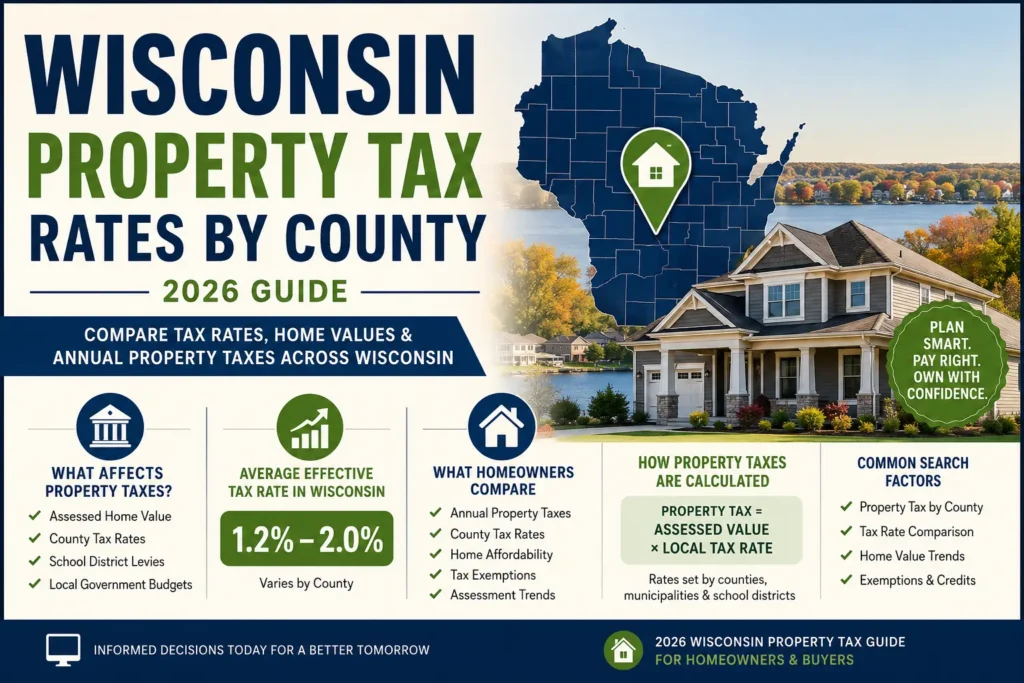
Wisconsin’s average property tax bill hits $3,746/year on a median $247,400 home one of the highest effective rates in the Midwest at 1.51%. Yet thousands of homeowners leave money on the table every single year because they don’t know which programs they qualify for, or they assume someone else already applied on their behalf.

This guide covers every major exemption and credit available in 2025–2026, who actually qualifies, what it’s worth in real dollars, and exactly how to claim it.
Quick Answer: Wisconsin does not offer a traditional homestead exemption. Instead, eligible homeowners, veterans, seniors, and low-income residents may qualify for property tax credits such as the Homestead Credit, Veterans Property Tax Credit, Lottery and Gaming Credit, First Dollar Credit, and WHEDA Property Tax Deferral Program.
What Wisconsin Actually Offers (It’s Credits, Not Exemptions)
Unlike Texas or Florida which slash your assessed value directly Wisconsin works through tax credits applied after your bill is calculated. That means the savings show up either as a line on your December property tax bill, or as a credit on your Wisconsin income tax return.
There are four main credit buckets:
| Credit | Who Gets It | How Applied | Approx. Value |
|---|---|---|---|
| Homestead Credit | Low-income homeowners & renters | State income tax return (Schedule H) | Up to $1,168/yr |
| Lottery & Gaming Credit | Owner-occupied primary residences | Automatic on tax bill | $150–$350/yr |
| First Dollar Credit | All improved residential properties | Automatic on tax bill | ~$63/yr |
| School Levy Tax Credit | All taxable properties | Automatic on tax bill | Varies by district |
| Veterans & Surviving Spouses Credit | 100% service-connected disabled vets | State income tax return | 100% of property taxes paid |
Combined, the automatic credits alone cut a typical Wisconsin residential tax bill by $300–$600 per year — without you filing a single form.
1. Homestead Credit — Up to $1,168/Year
This is the one most people miss, especially seniors and renters who don’t realize they qualify.
Who qualifies (2025 tax year):
- Wisconsin resident for the full year
- Household income under $24,680
- You own and occupy the property as your primary residence, OR you rented and paid rent on a primary residence
- Renters calculate 20% of annual rent as their “property tax equivalent”
Real example: A retired couple in Green Bay, both on Social Security, has household income of $19,400. They paid $3,200 in property taxes. Their Homestead Credit would be approximately $980 paid directly as a refund even if they owe zero state income tax.
How to claim: File Schedule H (or Schedule H-EZ for simpler situations) with your Wisconsin income tax return. Deadline is April 15 of the filing year. You can also file back claims up to 4 years meaning if you missed 2021, 2022, or 2023, you may still be able to claim.
⚠️ Conflict to know: You cannot claim the Homestead Credit AND the Veterans & Surviving Spouses Property Tax Credit on the same property taxes. If you’re a veteran, run the math the veterans credit is usually worth more.
2. Veterans & Surviving Spouses Property Tax Credit — Up to 100% of Taxes Paid
This is Wisconsin’s most powerful property tax relief program, and it’s underused because veterans assume they don’t qualify or that the VA handles it automatically. It does not happen automatically. You must apply through the Wisconsin Department of Veterans Affairs (WDVA).
Who qualifies:
- 100% service-connected disability rating from the VA, OR
- Individual Unemployability (IU) status (also called TDIU), OR
- Unremarried surviving spouse of a qualifying veteran
Residency requirement: You must have entered active duty from Wisconsin, OR maintained Wisconsin residency for at least 5 consecutive years after service.
What it’s worth: The credit equals 100% of the eligible property taxes paid during the year on the primary residence. On a $3,746 average tax bill, that’s $3,746 back paid as a refundable credit on your Wisconsin income tax return.
Real example: Marine veteran in Appleton, 100% P&T rated, pays $4,200/year in property taxes. His Veterans Credit = $4,200 credit filed on his state return. He gets a check for $4,200 even if he has no other tax liability.
How to claim (two steps):
- Get verified first — Contact WDVA at (800) 947-8387 or apply online at dva.wi.gov. You need your VA rating letter and DD-214.
- Claim the credit — Once WDVA confirms eligibility, file Schedule VA with your Wisconsin income tax return (Form 1 or 1A).
📅 Timing note: The eligible property taxes are those paid during January 1 through December 31 of the year you are claiming. Get your WDVA verification before December 31 so you can claim the full year.
3. Lottery & Gaming Credit — $150–$350 Applied Automatically
This is a direct property tax credit funded by state lottery and bingo revenue, applied automatically to owner-occupied primary residences. You’ll see it as a line item reduction on your December property tax bill.
Who qualifies: You own and occupy the property as your primary residence as of January 1 of the tax year.
If you bought a home mid-year or changed your primary residence, you may need to file a claim form with your municipal clerk by October 1 to get the credit applied.
What to do if it’s missing from your bill: Call your municipal treasurer’s office. If your property isn’t coded as owner-occupied homestead in the assessor’s records, you may be losing this credit every year without knowing it.
4. First Dollar Credit & School Levy Tax Credit — Both Automatic
The First Dollar Credit applies to all improved residential property homes, rentals, and some commercial improvements. It’s typically $75 to $150 per parcel and is applied automatically by the treasurer; no application required.
For 2025, the First Dollar Credit maximum value is set at $9,000 of assessed improvement value, translating to roughly $63 per parcel in most municipalities.
The School Levy Tax Credit is also calculated and applied automatically to your tax bill no form needed. The amount varies based on the school taxes levied against your property that year.
Bottom line on these two: You don’t need to do anything. Just verify they appear on your December tax bill. If they’re missing, call your county treasurer.
5. Senior Property Tax Deferral (Age 65+) — Stop Paying Now, Settle Later
No state income limit makes you ineligible here this is a loan program, not a credit.
The Property Tax Deferral Loan Program, administered by the Wisconsin Housing and Economic Development Authority (WHEDA), provides loans to help individuals age 65 or older pay their property taxes. Qualified applicants may participate even if they receive a homestead credit.
How it works: WHEDA pays your property tax bill directly to the county. The amount accumulates as a lien on your home at a low interest rate. You repay when you sell the home, refinance, or through your estate.
Application window: Applications must be filed with WHEDA between January 1 and June 30 of the year in which the taxes are due. All applicants must pay a $225 fee each year a loan application is submitted.
Best for: Seniors who are asset-rich but cash-flow constrained you keep the house, you stop the cash drain, and settlement happens later.
Quick Eligibility Checklist
Run through this before tax season:
☐ Homestead Credit
- Household income under $24,680?
- Primary residence in Wisconsin?
- Filed Schedule H with your state return?
☐ Veterans Credit
- 100% service-connected disability or TDIU?
- WDVA verification completed?
- Filed Schedule VA on your state return?
- Checked: you’re NOT also claiming Homestead on the same taxes?
☐ Lottery & Gaming Credit
- Owner-occupied primary residence as of January 1?
- Credit line appears on your December tax bill?
- If missing — claim form filed with municipal clerk by October 1?
☐ WHEDA Deferral (Seniors 65+)
- Age 65 or older?
- Application submitted between January 1–June 30?
Which Credits Can You Stack?
A common question and the answer matters.
| Credit A | Credit B | Can You Combine? |
|---|---|---|
| Lottery & Gaming Credit | Homestead Credit | ✅ Yes |
| Lottery & Gaming Credit | Veterans Credit | ✅ Yes |
| First Dollar Credit | Any of the above | ✅ Yes |
| School Levy Credit | Any of the above | ✅ Yes |
| Homestead Credit | Veterans Credit | ❌ No — choose one |
| School Property Tax Credit | Veterans Credit | ❌ No |
Rule of thumb: The automatic credits (Lottery, First Dollar, School Levy) stack with everything. The income-based Homestead Credit and the Veterans Credit conflict with each other always calculate both to see which saves you more.
What Most People Actually Miss (And Why)
1. Back-filing Homestead Credits. If your income qualified in 2021, 2022, or 2023 and you never filed Schedule H, you may still be able to claim those years. Qualified applicants can file four years prior for claim year 2021, the deadline is April 15, 2026.
2. Veterans at 90% who later got bumped to 100%. Your rating changed did you re-apply with WDVA? The credit only kicks in from the date of your 100% VA rating decision, but you can file amended returns once verified.
3. Surviving spouses who remarried, then divorced or were widowed again. Eligibility rules here are specific contact WDVA directly.
4. Lottery Credit on newly purchased homes. If you closed after January 1, the previous owner may have received that year’s credit. Verify it, and ensure your property is correctly coded for next year.
5. WHEDA for seniors who think they earn “too much.” There’s no income cap on the WHEDA deferral loan it’s available to any Wisconsin homeowner 65 or older.
How to Apply: Contact Directory
| Program | Agency | Phone | Website |
|---|---|---|---|
| Homestead Credit | Wisconsin DOR | 608-266-8641 | revenue.wi.gov |
| Veterans Credit | WDVA | 800-947-8387 | dva.wi.gov |
| Lottery & Gaming Credit | Municipal Clerk / County Treasurer | Contact your county | — |
| WHEDA Deferral | WHEDA | 800-334-6873 | wheda.com |
| First Dollar / School Levy | Automatic — verify on bill | County Treasurer | — |
Bottom Line
Wisconsin doesn’t offer a simple across-the-board homestead exemption like some other states. What it does offer is a layered system of credits some automatic, some requiring action that together can save a qualifying homeowner $1,500 to $4,200+ per year.
The most common mistake: assuming someone else filed it for you. For the Homestead Credit, Veterans Credit, and WHEDA deferral, you have to initiate the process yourself.
If you’re unsure where you stand, your county treasurer’s office and the Wisconsin DOR helpline (608-266-8641) are both free resources. AARP Foundation Tax-Aide also helps seniors file these credits at no cost during tax season.
Conclusion
Before paying your next property tax bill, take five minutes to review the programs above. Many Wisconsin homeowners qualify for at least one credit, and some veterans and seniors can save thousands of dollars annually. Even if you’ve missed credits in previous years, you may still be able to file retroactive claims and recover money that would otherwise be left on the table.
FAQ’S
Does Wisconsin have a homestead exemption?
No. Wisconsin does not offer a traditional homestead exemption that reduces assessed value. Instead, eligible residents may qualify for the Homestead Credit and other property tax relief programs.
Can I receive both the Homestead Credit and Veterans Property Tax Credit?
No. Wisconsin generally does not allow the same property taxes to be used for both credits.
Is the Lottery and Gaming Credit automatic?
Yes. Eligible owner-occupied primary residences usually receive the credit automatically on their property tax bill.
Can renters qualify for Wisconsin Homestead Credit?
Yes. Eligible renters may claim the Homestead Credit by using a portion of their rent as a property tax equivalent.
What is the age requirement for Wisconsin’s Property Tax Deferral Loan Program?
Applicants must generally be age 65 or older and meet WHEDA program requirements.
Important: Property tax credit eligibility, income limits, filing deadlines, and program requirements can change. Always verify current information through the Wisconsin Department of Revenue, WDVA, WHEDA, or your local county treasurer before applying.