Wisconsin isn’t the cheapest state to buy a home in, but it’s far from the most expensive and that distinction matters more than people realize.

The median home price here hit $338,200 in March 2026, up 8.5% from the previous year. That sounds steep until you compare it to the national median of roughly $440,000. You’re already starting from a better position than buyers in most of the country. And unlike states where first-time buyer assistance is thin on the ground, Wisconsin has a genuine infrastructure of programs state-level loans, down payment grants, federal backing, and city-specific funds that can meaningfully reduce what you need to bring to closing.
The problem isn’t that the programs don’t exist. It’s that nobody explains them clearly in one place. This guide does that.
Quick Answer: Wisconsin first-time home buyers can access WHEDA’s low-interest mortgage programs paired with the Easy Close DPA which provides up to 6% of the purchase price toward your down payment and closing costs. Federal options like FHA (3.5% down, 580+ credit), USDA (0% down for rural areas), and VA loans (0% down for veterans) are also available. The main state agency to know is WHEDA (Wisconsin Housing and Economic Development Authority), which works through approved lenders statewide.
Table of Contents
Who Counts as a “First-Time Home Buyer” in Wisconsin?
Here’s something worth knowing before you assume you don’t qualify: you don’t have to be buying your first home ever.
Under Wisconsin’s definition and the definition used by most federal programs a first-time home buyer is anyone who hasn’t owned a primary residence in the past three years. That means if you owned a home ten years ago, sold it, and have been renting since, you qualify. Divorced homeowners who haven’t owned since the split can qualify. Even someone who owned a vacation property but not a primary residence may qualify depending on the program.
The three-year rule opens these programs up to more people than most guides acknowledge.
Core Eligibility Requirements
Beyond the ownership history, here’s what programs generally require:
Credit score: Minimum 620 for WHEDA Advantage Conventional and standard conventional loans. WHEDA’s FHA-backed loan requires 640 notably stricter than the FHA national floor of 580. If your score falls between 580 and 639, you can still use an FHA loan through a non-WHEDA lender, you just won’t have access to WHEDA’s rate advantages.
Income limits: Most WHEDA programs cap household income at 80–140% of the Area Median Income (AMI), depending on county and household size. In Milwaukee County, the AMI for a family of four is approximately $100,000 in 2026. Income limits are calculated on total household income everyone age 18 or older who will live in the home.
Purchase price limits: Vary by county, typically ranging from $300,000 to $450,000 under WHEDA programs. Some counties in southeastern Wisconsin have higher limits reflecting local market prices.
Primary residence only: Every program covered in this guide requires you to live in the property. These aren’t available for investment properties or vacation homes.
Homebuyer education: Required for all WHEDA programs and most DPA programs. You complete it once online, receive a certificate, and you’re done. More on this below.
DTI ratio: Your total debt-to-income ratio including the new mortgage payment should not exceed 50%. Most lenders prefer it under 43%.
Who Doesn’t Qualify (Common Situations)
If your household income is above WHEDA’s county limits, you’ll need to look at conventional or federal options without the WHEDA rate benefit. WHEDA also has a soft requirement that the home be within 50 miles of your workplace not a hard disqualifier, but worth noting.
WHEDA Loan Programs – Wisconsin’s State Housing Authority
WHEDA is the Wisconsin Housing and Economic Development Authority, and it’s the centerpiece of first-time buyer assistance in this state. Understanding what it is and isn’t will save you confusion.
WHEDA doesn’t lend money directly. It sets the loan terms interest rates, eligibility rules, income limits and then works through a network of approved private lenders (banks, credit unions, mortgage companies) who actually originate the loans. When you get a “WHEDA loan,” you’re getting a mortgage from a participating lender at a WHEDA-negotiated rate, often 0.25–0.5% below what you’d find on your own.
That rate difference compounds. On a $338,000 30-year mortgage, even a 0.25% rate reduction saves roughly $17,000 in interest over the life of the loan.
WHEDA Advantage Conventional Loan
This is WHEDA’s most popular first mortgage product. It follows Fannie Mae’s underwriting guidelines, which means it behaves like a standard conventional loan but at a lower interest rate than you’d typically get.
- Minimum credit score: 620
- Minimum down payment: 3%
- Property must be primary residence for the life of the loan
- Income and purchase price limits apply by county
- PMI required if down payment is under 20%
- Can be combined with WHEDA’s Easy Close DPA (see below)
Best for buyers with solid credit who want the conventional loan structure without FHA’s mortgage insurance premiums.
WHEDA Advantage FHA Loan
Same WHEDA rate benefit, but backed by the Federal Housing Administration. The FHA backing means more flexible underwriting useful if your credit history has some blemishes or your debt-to-income ratio is higher.
- Minimum credit score: 640 (WHEDA’s overlay, stricter than FHA’s standard 580)
- Minimum down payment: 3.5%
- Upfront MIP of 1.75% + annual MIP applies
- Income and purchase price limits apply
One thing to understand about FHA mortgage insurance: it may stay for the life of the loan depending on your down payment. If you put down less than 10%, FHA’s annual MIP doesn’t cancel automatically the way conventional PMI does. This is worth factoring into your long-term cost calculation.
WHEDA Valor Loan (For Veterans)
Wisconsin’s acknowledgment that veterans shouldn’t have to jump through the same first-time buyer hoops.
The Valor loan waives the first-time buyer requirement entirely, so veterans who have owned homes before still qualify. It offers a reduced interest rate below even standard WHEDA rates and can be layered with down payment assistance. A DD-214 is required; a VA Certificate of Eligibility doesn’t substitute for it under this program.
For veterans choosing between WHEDA Valor and a standard VA loan: VA loans offer 0% down and no PMI, which Valor doesn’t automatically provide. The two programs serve different situations if you qualify for VA, run the numbers on both.
WHEDA Rural Target Area Program
If you’re buying in one of Wisconsin’s 15 designated rural counties, WHEDA offers a further reduced interest rate specifically for those areas.
The eligible counties are: Ashland, Barron, Bayfield, Burnett, Clark, Crawford, Iron, Jackson, Juneau, Marinette, Marquette, Oconto, Rusk, Sawyer, and Trempealeau.
This is worth knowing if you’re considering a move away from Wisconsin’s urban centers. A lower rate plus the already-lower home prices in these counties can meaningfully change what monthly payment looks like.
WHEDA Homebuyer Education Requirement
Every WHEDA program requires completion of a homebuyer education course before closing. This isn’t optional, and it can’t be done retroactively after you’ve found a property start it early.
Online courses through Framework or eHome America run approximately $75–$99 and take 4–6 hours to complete. The certificate you receive doesn’t expire immediately, so completing it before you start actively house-hunting makes sense. Your WHEDA-approved lender will provide specific instructions on which platforms are accepted.
WHEDA Program Comparison
| Program | Min Credit | Down Payment | Best For |
|---|---|---|---|
| Advantage Conventional | 620 | 3% | Solid credit, wants conventional structure |
| Advantage FHA | 640 | 3.5% | Higher DTI, more flexible qualifying |
| Valor | 620 | 3% | Veterans, waives first-time buyer rule |
| Rural Target Area | 620 | 3% | Buyers in 15 designated rural counties |
Down Payment Assistance in Wisconsin – What’s Actually Available
Down payment assistance (DPA) is where a lot of buyers get confused, mainly because “assistance” covers two different things: loans you repay and grants you don’t. The distinction matters.
WHEDA Easy Close DPA
This is the primary down payment assistance program in Wisconsin and the one most buyers will use.
What it is: A second mortgage not a grant ranging from $1,000 up to 6% of the home’s purchase price. On a $338,200 home, 6% equals roughly $20,300.
How it works: It’s structured as a 10-year fixed-rate second mortgage with equal monthly payments. You repay it alongside your primary mortgage. The interest rate is typically competitive check current rates with your WHEDA lender.
Requirements: Must be paired with a WHEDA first mortgage (Conventional or FHA). You still need to meet WHEDA’s income and purchase price limits. The same homebuyer education certificate is required.
The honest take: Easy Close DPA reduces your cash needed at closing significantly, but it does add a second monthly payment. Budget for both when you’re calculating what you can afford.
Downpayment Plus (Federal Home Loan Bank of Chicago)
This one is a true grant it doesn’t need to be repaid.
Available through FHLB Chicago’s participating member lenders in Wisconsin, Downpayment Plus provides a 3:1 match on the buyer’s own saved funds, up to $6,000. If you’ve saved $2,000 toward a down payment, Downpayment Plus adds $6,000, giving you $8,000 total.
Income eligibility applies (generally at or below 80% AMI). Not every lender participates, so you need to specifically ask whether your lender is an FHLB Chicago member offering this program.
Wisconsin’s Proposed First-Time Homebuyers Act (2026)
In January 2026, State Senator Dora Drake and Representative Kalan Haywood introduced the First-Time Homebuyers Act legislation that, if passed, would create one of the more substantial assistance programs in the state.
Key terms as proposed:
- Interest-free loan of up to $35,000 or 10% of the purchase price, whichever is lower
- 50% of the loan forgiven after 10 continuous years of owner-occupancy
- Full forgiveness possible in cases of financial hardship (at WHEDA’s discretion)
- Income at or below 100% of area median income
- Minimum $1,000 personal contribution from the buyer
- Must use a WHEDA-administered first mortgage
Important: As of this writing, this is proposed legislation not yet enacted. Check WHEDA’s website or ask your lender whether this program has been signed into law before factoring it into your plans.
NeighborhoodLift and HomeLift (When Active)
Wells Fargo and other major lenders periodically run NeighborhoodLift and HomeLift programs in Wisconsin cities, typically Milwaukee and Madison. When active, these offer $15,000–$25,000 in down payment grants with income requirements.
These programs aren’t permanent they run for limited periods with limited funds. To find out if one is currently active, search “NeighborhoodLift [city name] 2026” or check with a HUD-approved housing counselor.
Federal Loan Programs Available in Wisconsin
WHEDA programs layer on top of federal mortgage products they don’t replace them. Here’s how the main federal options work for Wisconsin buyers.
FHA Loans
The Federal Housing Administration loan is the most common choice for first-time buyers nationally, and Wisconsin is no different.
- Minimum credit score: 580 with 3.5% down, or 500 with 10% down
- Available through any FHA-approved lender (not just WHEDA lenders)
- FHA loan limit for most Wisconsin counties: approximately $498,257 in 2026
- Upfront MIP: 1.75% of loan amount (can be rolled into the loan)
- Annual MIP: approximately 0.55%, added to monthly payment
If your credit score is 580–639, you’re in a specific gap: FHA nationally allows you, but WHEDA’s FHA overlay requires 640. Your path is an FHA loan through a non-WHEDA lender you get the FHA benefits but not the WHEDA rate reduction. Worth still considering, especially if you’re close to 640 and can get there with a few months of credit work.
USDA Loans
Zero down payment, competitive rates, backed by the US Department of Agriculture. Wisconsin’s rural character means more of the state qualifies than most buyers expect.
- No down payment required
- Income limit: generally 115% of area median income
- Credit score: 620+ preferred (640+ for streamlined processing)
- Property must be in a USDA-designated eligible area
The misconception about USDA is that it’s only for farms or very remote areas. That’s not true in Wisconsin. Many communities within reasonable commuting distance of Green Bay, Appleton, Wausau, and even Madison’s outer suburbs fall within USDA eligible zones. The USDA’s property eligibility map at eligibility.sc.egov.usda.gov lets you check any specific address.
VA Loans
For veterans, active-duty service members, and surviving spouses, VA loans are the best mortgage product available period.
- No down payment required
- No private mortgage insurance
- No income limits
- Flexible credit requirements (most lenders want 620+)
- VA funding fee applies: 2.15% for first use (waived entirely for veterans with 10%+ service-connected disability)
The funding fee can be rolled into the loan, so there’s typically no out-of-pocket cost for it. Wisconsin has a substantial veteran population, and VA loans are significantly underused relative to the number of people who qualify.
Conventional 97 / Fannie Mae HomeReady
If you exceed WHEDA’s income limits but still want a low down payment, these conventional options fill the gap.
- Conventional 97: 3% down, credit score 620+, no income limits
- HomeReady: 3% down, income must be at or below 80% AMI, includes a $2,500 credit toward down payment or closing costs for qualifying buyers, credit score 620+
HomeReady also allows gift funds, DPA grants, and even rental income from an accessory dwelling unit to count toward qualifying income — useful in more situations than standard conventional loans.
Good Neighbor Next Door Program
A federal program worth knowing if you work in certain public service fields: teachers (pre-K through 12th grade), law enforcement officers, firefighters, and EMTs can buy HUD-owned homes in designated revitalization areas at a 50% discount off the listing price.
The catch: you must live in the home as your primary residence for at least three years. Listings are competitive often available for only a few days before the lottery closes. But when it works, it’s the most dramatic price reduction available to any Wisconsin buyer.
Check current Wisconsin listings at hudhomestore.gov.
City-Specific Programs Worth Knowing
Statewide programs get most of the attention, but some of the best assistance in Wisconsin is local.
Madison — Home-Buy the American Dream
The City of Madison runs a down payment and closing cost assistance program for low-to-moderate income first-time buyers purchasing within city limits. Administered through the city’s Community Development Division, it targets buyers below 80% AMI.
Details and current funding availability: cityofmadison.com/dcr/housing.
Milwaukee — Nonprofit and Bank Programs
Milwaukee has the most layered assistance ecosystem in the state, reflecting both the city’s affordability challenges and the concentration of housing nonprofits.
ACTS Housing helps buyers in Milwaukee find and finance homes, including guidance on which assistance programs apply to their situation. Housing Resources Incorporated (HRI) is a statewide nonprofit that maintains a current database of Wisconsin grant and assistance programs their listing is more up to date than most static guides.
Milwaukee also periodically sees NeighborhoodLift activations from major banks. Checking with a HUD-approved housing counselor in Milwaukee is the most reliable way to find what’s currently active.
Green Bay, Racine, Kenosha, and Mid-Size Cities
Most Wisconsin cities with significant populations run some version of a CDBG (Community Development Block Grant) funded first-time buyer program through their housing or community development departments. These change frequently funding runs out, programs pause, new ones launch.
The most reliable approach: call the city’s housing or community development office directly and ask what’s currently available. A ten-minute phone call often surfaces programs that don’t appear in any guide.
Habitat for Humanity (Statewide)
Wisconsin has active Habitat chapters in Milwaukee, Madison, Green Bay, Fox Cities, and other regions. Habitat offers 0% interest mortgages with a sweat equity requirement buyers contribute labor hours to their own and other Habitat homes.
This isn’t a conventional home purchase, and it’s not fast. But for buyers at very low income levels who can’t qualify for standard financing, Habitat is a legitimate path to ownership that most guides dismiss too quickly.
Step-by-Step: How to Buy Your First Home in Wisconsin
Understanding the programs is one thing. Knowing the actual sequence of steps and when to do each one is what keeps buyers from losing deals or missing out on assistance they qualified for.
Step 1: Pull Your Credit and Address Any Issues
Get your free reports at AnnualCreditReport.com all three bureaus. Look for errors (dispute them immediately they take 30 days to resolve), high utilization on revolving accounts (pay balances below 30% of the credit limit), and any collections or late payments that might be dragging your score.
Minimum target: 620 for conventional, 640 if you want WHEDA FHA. If you’re at 590, you’re often 60–90 days of disciplined credit management away from qualifying don’t give up.
Step 2: Complete Your Homebuyer Education Course
Do this before you start seriously shopping for homes. WHEDA requires the certificate, and it needs to come from a WHEDA-approved provider. Framework (frameworkhomeownership.org) and eHome America (ehomeamerica.org) both offer the online course for around $75–$99.
The course covers budgeting, understanding your mortgage documents, the closing process, and post-purchase maintenance. Even if you feel like you already know this material, the certificate is a prerequisite and can’t be skipped.
Step 3: Get Pre-Approved with a WHEDA-Approved Lender
Pre-approval is not the same as pre-qualification. Pre-qualification is a rough estimate based on what you tell the lender. Pre-approval involves actually submitting documents W-2s, pay stubs, bank statements, tax returns and having the lender verify your credit and income.
In Wisconsin’s current market, sellers in the under-$350,000 range often won’t consider offers without a pre-approval letter. Get it before you start touring homes.
To find WHEDA-approved lenders: wheda.com has a searchable lender directory. Interview at least two or three lenders rates and fees vary even within the WHEDA program.
Documents to gather:
- Last two years of W-2s (or tax returns if self-employed)
- Most recent 30 days of pay stubs
- Last two months of bank statements (all accounts)
- Government-issued ID
- Social Security number
Step 4: Apply for Down Payment Assistance at the Same Time
This is the step that trips up the most first-time buyers. DPA programs especially Easy Close DPA aren’t applied for separately after you find a home. They’re part of your mortgage application from the beginning.
Tell your lender upfront that you want to apply for Easy Close DPA or any other assistance. If they’re not a WHEDA-approved lender, they can’t offer Easy Close DPA, which is another reason why choosing a WHEDA lender matters.
For Downpayment Plus, confirm with your lender whether they’re an FHLB Chicago participating member before you assume it’s available to you.
Step 5: Work with a Buyer’s Agent
In Wisconsin, the seller pays both the listing agent’s commission and the buyer’s agent commission so using a buyer’s agent costs you nothing directly. Given that, not using one is leaving professional representation on the table for free.
Look for an agent with experience specifically in first-time buyer transactions and familiarity with WHEDA and DPA timelines. WHEDA transactions can take slightly longer to close than conventional loans, and an experienced agent knows how to set expectations with sellers accordingly.
Step 6: Make an Offer in a Competitive Market
Under $350,000 in Wisconsin’s major markets Madison, Milwaukee, Green Bay, Waukesha County you’ll likely compete with multiple offers, especially for move-in ready properties.
A few practical notes:
- Keep your inspection contingency. In Wisconsin, you have the right to a home inspection and there’s almost no situation where waiving it entirely is a good idea.
- Escalation clauses (offers that automatically increase up to a ceiling if competing offers come in) can help without requiring you to blindly overbid.
- Wisconsin law requires sellers to complete a Real Estate Condition Report disclosing known material defects — review it carefully before making an offer.
Step 7: Home Inspection and Appraisal
Inspection: Runs $300–$500 depending on home size and age. The inspector works for you, not the lender. Pay for a thorough one — Wisconsin’s older housing stock (especially in Milwaukee, Racine, and Kenosha) can have issues that only show up on a proper inspection.
Appraisal: Ordered by your lender, paid by you ($400–$600 typically). The appraisal confirms the home is worth what you’re paying. If it comes in low, you have options: renegotiate the price, pay the difference in cash, or in some cases challenge the appraisal with comparable sales data.
FHA and USDA appraisals have additional property condition requirements beyond value. Peeling paint, exposed wood rot, missing handrails, and non-functional systems can require repairs before the loan closes. Know this going in if you’re buying an older home.
Step 8: Closing Day
Wisconsin closing costs typically run 2–5% of the purchase price. On a $338,200 home, that’s $6,764 to $16,910. Items include:
- Lender origination and processing fees
- Title insurance (owner’s and lender’s)
- Recording fees
- Prepaid property taxes (typically two months)
- Prepaid homeowner’s insurance (first year upfront)
- Prepaid mortgage interest (from closing date to end of month)
You’ll receive a Closing Disclosure (CD) at least three business days before your closing date. Read every line. Bring a cashier’s check or confirm wire transfer details with your title company and confirm those details by phone using a number you find independently, not from an email, to avoid wire fraud.
The True Cost of Homeownership in Wisconsin — Beyond the Down Payment
A lot of first-time buyers calculate affordability based on the mortgage payment alone and then get caught off guard by everything else. Here’s what to actually budget for.
Property taxes: Wisconsin’s average effective property tax rate is approximately 1.6% above the national average. On a $338,200 home, that’s roughly $5,411 per year, or about $451 per month added to your housing cost. Tax rates vary significantly by county and municipality Milwaukee County runs higher, rural counties lower. Your lender’s payment estimate should include an escrow amount for taxes, but verify it.
Homeowner’s insurance: Average annual premium in Wisconsin is approximately $1,200–$1,800 depending on location, home age, and coverage level. Your lender requires you to have it, and you’ll typically prepay the first year at closing.
Private mortgage insurance (PMI): If you put down less than 20% on a conventional loan, PMI runs approximately 0.5–1.5% annually. On a $338,200 loan, 1% PMI = $282/month. The good news: on conventional loans, PMI cancels automatically when you reach 78% LTV (Loan-to-Value). FHA’s MIP works differently if you put down less than 10%, it stays for the life of the loan.
Maintenance reserves: The standard guidance is 1–2% of home value annually. On a $338,200 home, that’s $3,382–$6,764/year set aside for repairs. Wisconsin winters specifically mean you should budget for roof maintenance, furnace servicing, water heater replacement, and potential foundation drainage issues particularly in older homes.
Wisconsin Housing Market in 2026 — Context for First-Time Buyers
Knowing the market conditions helps you set realistic expectations before you start.
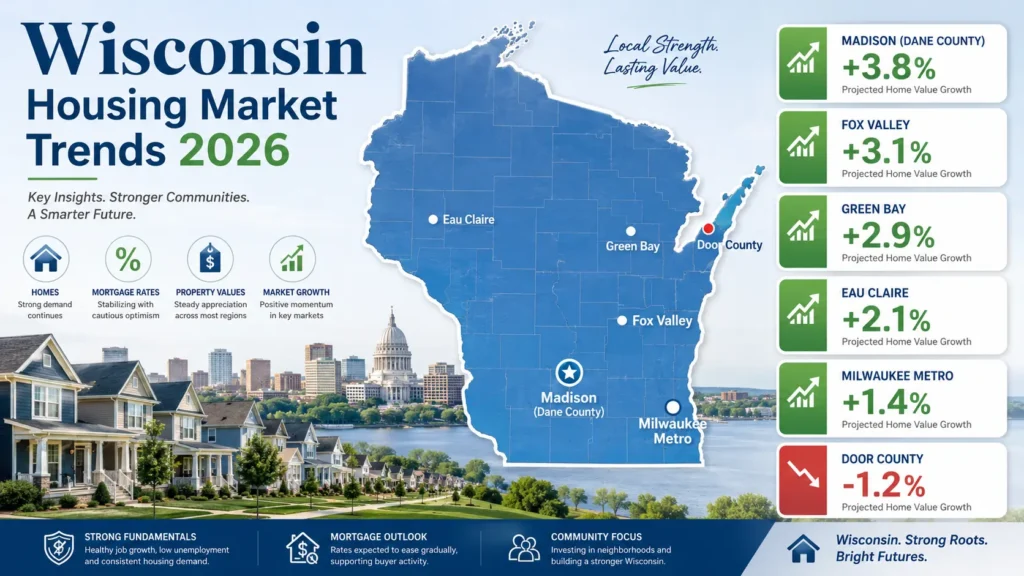
The statewide median of $338,200 masks significant variation. Madison and its suburbs are the most competitive market in the state, with median prices well above $400,000 and inventory remaining tight. Milwaukee County is more varied some neighborhoods are genuinely affordable, others have seen rapid appreciation. Waukesha County tends to run higher than Milwaukee proper.
For buyers willing to look at mid-size Wisconsin cities, the picture is different. Wausau, La Crosse, Eau Claire, Oshkosh, and Appleton offer a combination of employment, services, and home prices that are meaningfully lower than the Madison-Milwaukee corridor. Some of Wisconsin’s most affordable markets Beloit, Marinette, Antigo have median prices in the $160,000–$180,000 range where even a 3% down payment is a manageable savings goal.
One practical note on interest rates: WHEDA’s rate advantage is most valuable when market rates are higher, because the spread between WHEDA and market rates tends to be consistent. Get quotes from at least two WHEDA-approved lenders and compare the annual percentage rate (APR) not just the stated interest rate to make an accurate comparison.
Frequently Asked Questions
What credit score do I need to buy a house in Wisconsin?
It depends on the loan type. For WHEDA’s Advantage Conventional loan, the minimum is 620. WHEDA’s FHA product requires 640. If you go with a non-WHEDA FHA lender, scores as low as 580 qualify with a 3.5% down payment. VA and USDA loans don’t have hard minimums set by the agencies, though most Wisconsin lenders want 620 or higher.
How much down payment do I need as a first-time buyer in Wisconsin?
As little as 0% if you qualify for a VA or USDA loan. FHA requires 3.5% minimum (with a 580+ score). WHEDA Conventional starts at 3%. With Easy Close DPA, you can cover that 3% entirely with the second mortgage, meaning your out-of-pocket cash at closing could consist mainly of closing costs rather than a down payment.
What is the income limit for WHEDA programs in 2026?
WHEDA income limits vary by county and household size. In Milwaukee County, the limit for a family of four is approximately $100,000. Dane County (Madison) limits are similar. Income limits are lower in rural counties. The most accurate source is the current income limit table on wheda.com — limits were updated effective January 15, 2026.
Are there actual grants for first-time home buyers in Wisconsin that don’t need to be repaid?
The Downpayment Plus program through FHLB Chicago is a true grant (up to $6,000, no repayment required) available through participating lenders. The WHEDA Easy Close DPA is a loan, not a grant this distinction is important and often misrepresented. Some city-specific programs in Madison and Milwaukee may offer forgivable loans that function like grants if you stay in the home for a set period.
Can I buy a house in Wisconsin with no down payment?
Yes — two ways. USDA loans cover properties in eligible rural and semi-rural areas with no down payment required. VA loans are available to veterans and eligible service members with no down payment and no PMI. For buyers who don’t qualify for either, pairing a WHEDA loan with Easy Close DPA can reduce required cash at closing to near zero in some cases, though the DPA is a loan you’ll repay over 10 years.
What is the WHEDA Easy Close DPA and how does it work?
Easy Close DPA is a second mortgage not a grant that provides between $1,000 and 6% of your home’s purchase price toward your down payment and closing costs. It’s structured as a 10-year fixed-rate loan with equal monthly payments. You apply for it simultaneously with your WHEDA first mortgage through a WHEDA-approved lender. It reduces the cash you need at closing but adds a second payment to your monthly housing cost.
Do I have to be a Wisconsin resident to use these programs?
You must intend to occupy the property as your primary residence, but you don’t have to already live in Wisconsin to apply. Out-of-state buyers relocating to Wisconsin for work are typically eligible as long as the property will be their primary home and they meet all other program requirements.
Where to Start
If this is your first time looking at all of this, here’s the practical sequence: pull your credit report this week, complete the WHEDA homebuyer education course if your score is already where it needs to be, then contact two or three WHEDA-approved lenders for pre-approval conversations. Those conversations will quickly clarify which programs apply to your specific income, credit, and target area.
The programs exist. The question is whether you take the time to access them.
Editorial Note
This guide is for informational and educational purposes only. Information is based on publicly available sources such as WHEDA, HUD, FHA, and USDA Rural Development. Program details like eligibility, limits, and rates may change over time.
Please verify all details with official agencies or approved lenders before making any financial decisions. This website is an independent resource and is not affiliated with any government agency.