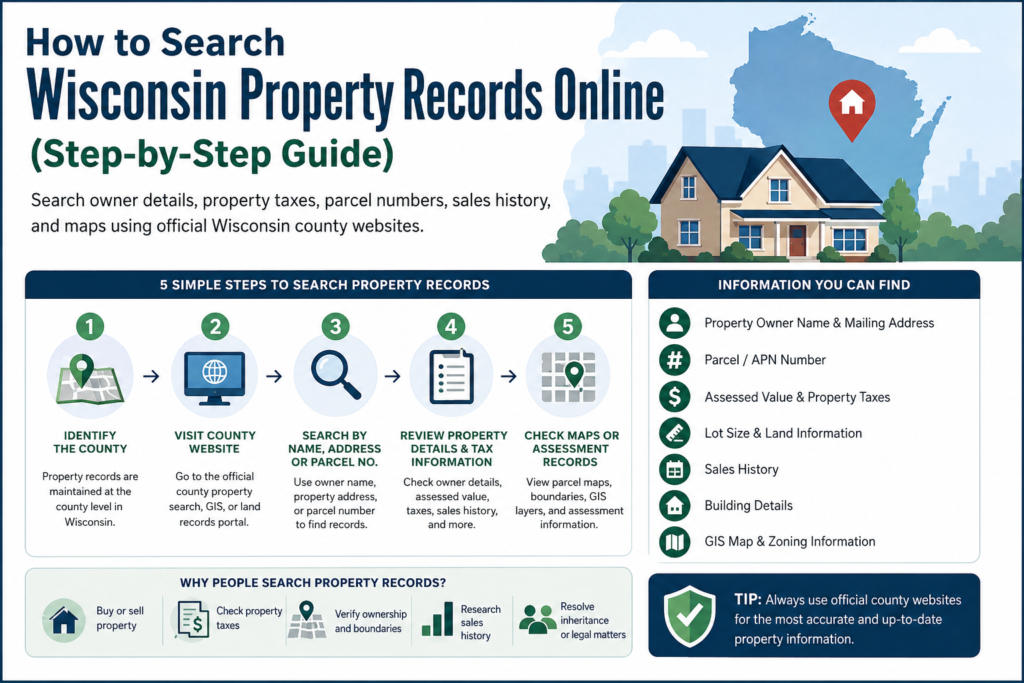
Getting a copy of your property deed in Wisconsin is simpler than most people expect but the process varies depending on which county the property is in, whether you want a certified or uncertified copy, and how quickly you need it. This guide covers exactly what to do, county by county, so you’re not wasting time calling the wrong office or showing up without the right information.
To get a copy of a property deed in Wisconsin, contact the Register of Deeds office in the county where the property is located. Most counties offer online deed searches, while certified copies usually require an in-person, mail, or official request.
What Is a Property Deed and Why Would You Need a Copy?
A deed is the legal document that transfers ownership of real property from one person (or entity) to another. Once a deed is signed and recorded with the county, it becomes a public record. That recorded copy is what you’ll request when you need proof of ownership.
Common reasons people request deed copies in Wisconsin:
- Refinancing or applying for a home equity loan
- Settling an estate after a death
- Resolving a boundary or ownership dispute
- Confirming easements or restrictions on the property
- Title research before buying or selling land
- Updating ownership after a divorce or name change
Whatever the reason, the process starts in the same place: the Register of Deeds office in the county where the property is located.
Register of Deeds vs. County Clerk — Which Office Do You Contact?
This trips people up more than anything else. In Wisconsin, property deeds are recorded and maintained by the Register of Deeds, not the County Clerk. These are two separate offices, and calling the wrong one will just send you in circles.
The County Clerk handles elections, licenses, and county board records. The Register of Deeds handles recorded documents deeds, mortgages, liens, plats, and easements.
A few Wisconsin counties have combined these offices under one roof, but even then, it’s the Register of Deeds function you need. When in doubt, call and ask specifically for the Register of Deeds.
What You’ll Need Before You Request
You don’t need much, but having the right information upfront saves time.
Property address — This is usually enough to start a search online or in person.
Parcel ID (PIN) — If you have it, great. If not, the county can usually look it up from the address.
Grantor/Grantee name — For older deeds or historical research, having the owner’s name (or the name of the person who sold them the property) helps narrow down the search.
Document number — If you’ve done any title research and have the recording number from a previous transaction, you can request the deed directly by document number, which is the fastest route.
You do not need to prove ownership to request a deed copy in Wisconsin. Deeds are public records, and anyone can request them.
Certified vs. Uncertified Copies — What’s the Difference?
An uncertified copy is a standard photocopy or digital scan of the recorded deed. It’s fine for personal reference, estate research, or general property information.
A certified copy includes an official stamp or seal from the Register of Deeds confirming it’s a true and accurate copy of the recorded document. Lenders, courts, and some government agencies require a certified copy so if you’re refinancing, probating an estate, or involved in litigation, make sure you request certified.
| Uncertified Copy | Certified Copy | |
|---|---|---|
| What it is | Plain photocopy or digital scan | Official copy with county stamp/seal |
| Accepted by lenders? | No | Yes |
| Accepted by courts? | No | Yes |
| Good for personal use? | Yes | Yes |
| Available online? | Usually yes | Rarely — most counties require in-person or mail |
| Typical cost | $1–$2 per page | $2–$5 per page + $1–$3 certification fee |
| How fast | Immediate (online) | Same day (in-person) or 1–2 weeks (mail) |
Quick rule: If it’s going to a bank, court, or attorney get certified. For everything else, uncertified is fine.
How to Get a Copy of a Wisconsin Property Deed
- Identify the county where the property is located.
- Contact the county Register of Deeds office.
- Search using the address, parcel ID, or owner name.
- Choose certified or uncertified copy.
- Pay the required fee.
- Download or receive the deed copy.
How to Get Your Deed: Three Ways
1. Online (Fastest Option for Most Counties)
Most Wisconsin counties now have online land records portals where you can search for and download deed copies without calling or visiting anyone. Some are free; others charge a small fee per document.
The search process is usually the same: enter the address or parcel ID, find the deed in the results, and download or print it. For certified copies, you’ll typically need to order through the county office directly online portals usually provide uncertified copies only.
2. In Person at the Register of Deeds
If you need a certified copy, want to do deep historical research, or just prefer to handle it in person, visiting the Register of Deeds office is the most reliable route. Staff can help you search records and will certify copies on the spot in most counties.
Bring the property address and any identifying information you have. Most offices have public search terminals available during business hours.
3. By Mail or Email Request
Most county Register of Deeds offices accept written requests for deed copies. You’ll need to provide the property address or document number, specify whether you need certified or uncertified, and include payment (check or money order, depending on the county). Processing times vary from a day or two to a couple of weeks.
Some counties now accept email requests with payment by card worth checking their website before mailing a check.
Step-by-Step: How to Request Your Deed (Quick Checklist)
Whether you’re going online, in person, or by mail, these steps apply in every Wisconsin county.
Step 1 — Identify the county. The deed is recorded in the county where the property physically sits, not where you live.
Step 2 — Decide what type of copy you need. Certified for legal/financial use. Uncertified for everything else.
Step 3 — Gather your information. Property address is usually enough. Parcel ID or document number speeds things up.
Step 4 — Choose your method. Online is fastest for uncertified copies. In-person is best for certified copies or old records.
Step 5 — Search the records. Use the county’s online portal or the public terminals at the Register of Deeds office.
Step 6 — Confirm it’s the most recent deed. Sort results by recording date. Don’t assume the first result is current.
Step 7 — Pay the fee and get your copy. Online payments are usually card. In-person accepts cash or check. Mail requests typically require a check or money order.
Step 8 — Verify the document. Check that the names, legal description, and parcel ID match the property you’re researching before you use the copy for anything official.
County by County Guide
Here’s where to go for deed copies in Wisconsin’s major counties.
Dane County
The Dane County Register of Deeds office is located in Madison at the City-County Building. Their online land records system accessible through the county website allows free document searches and paid downloads of recorded documents. Certified copies require an in-person or mail request. The office handles a high volume of requests, so online is usually the fastest option for standard uncertified copies.
Milwaukee County
Milwaukee County Register of Deeds operates out of the County Courthouse in downtown Milwaukee. Their online portal (Milwaukee County Land Records) provides searchable access to recorded documents going back several decades. For older records or certified copies, the office can be contacted directly. Given the volume of transactions in the county, document numbers are the fastest search method if you have them.
Waukesha County
Waukesha County Register of Deeds maintains an online records system through the county’s land information portal. Searches are free, and document images are available for a per-page fee. Certified copies require either an in-person visit or a mail request to the Waukesha County Courthouse in Waukesha.
Brown County
Brown County (Green Bay area) provides online access to land records through the Register of Deeds office website. The county has digitized records going back many years, making it possible to pull older deeds without visiting in person. Certified copy requests can be submitted by mail or in person at the Green Bay courthouse.
Rock County
Rock County Register of Deeds is based in Janesville. Their online portal allows property searches by address, owner name, or document number. For properties in Beloit or other municipalities within Rock County, the same office handles all recorded documents there’s no separate city-level recording system.
La Crosse County
La Crosse County’s Register of Deeds office handles property records for the city of La Crosse and all townships in the county. Online search access is available through the county’s website. For shoreland and riverfront properties along the Mississippi, the deed may also reference recorded easements or DNR agreements worth requesting the full document rather than just a summary.
Outagamie County
Outagamie County (Appleton area) Register of Deeds provides online land records access. The county has made a consistent effort to digitize older records, so historical deed research is more accessible here than in some smaller counties. In-person service is available at the county courthouse in Appleton.
Winnebago County
Winnebago County (Oshkosh, Neenah) maintains land records through the Register of Deeds at the county courthouse in Oshkosh. Their online records system supports searches by name, address, and document number. Certified copies are available by mail or in person.
Marathon County
Marathon County Register of Deeds is located in Wausau. Online records access is available through the county website. For rural parcels in the county’s northern townships, older deeds may reference original government survey descriptions (township, range, section, quarter section) the Register of Deeds staff can help interpret those if needed.
Eau Claire County
Eau Claire County provides land records access through the county’s Register of Deeds portal. The office is located in the Eau Claire County Courthouse. For properties that changed hands multiple times, staff can help trace the chain of title through recorded deeds if you need more than just the current deed.
Sauk County
Sauk County Register of Deeds is in Baraboo. Given the county’s tourism and resort property market around Wisconsin Dells and Devil’s Lake, the office handles a range of property types residential, commercial, vacation properties, and agricultural land. Online records are searchable through the county website.
Washington County
Washington County Register of Deeds operates out of West Bend. Their land records portal provides online search and document access. Washington County has seen significant residential development in recent decades, so most records here are well-digitized and accessible online.
A Real Example: What This Actually Looks Like
Here’s how this plays out in practice.
A woman in Milwaukee inherited her mother’s home on the north side of the city after she passed away in 2023. The mortgage was paid off years ago, and there was no formal estate plan just a will leaving the property to her. Her attorney told her she needed a certified copy of the current deed to begin the transfer process.
She went to the Milwaukee County Register of Deeds at the courthouse on West Kilbourn Avenue. She gave them her mother’s name and the property address. Staff pulled up the deed recorded when her parents originally bought the house in 1987 and printed a certified copy on the spot. Total cost was around $10 for two pages plus the certification fee. The whole thing took about 20 minutes.
Her attorney used that certified copy to prepare a new deed transferring ownership into her name, which then got recorded back at the same office.
That’s the typical flow: request the existing deed, use it for whatever legal or financial purpose you need, and if ownership is changing, a new deed gets recorded to reflect that. You’re not “updating” the old deed you’re creating a new recorded document on top of it.
What If the Property Is Very Old?
For deeds recorded before county digitization often anything before the 1980s or earlier in smaller counties you may need to visit the Register of Deeds in person and search physical index books or microfilm records. Staff are accustomed to these requests and can guide you through the process.
For very old properties (pre-1900), the State Historical Society of Wisconsin and the Wisconsin Land Records History Project can be useful supplementary resources, particularly for abstract and chain-of-title research.
Fees — What to Expect
Wisconsin sets a base recording fee structure, but counties can add their own charges. As a general baseline:
- Certified copy: typically $2–$5 per page plus a $1–$3 certification fee
- Uncertified copy: usually $1–$2 per page or a flat fee per document
- Online downloads: varies by county some are free, others charge per document
Call the specific county’s Register of Deeds before mailing a request so you know the exact fee and accepted payment methods. Sending the wrong amount will delay your request.
A Few Things Worth Knowing
The deed you find may not be the most recent. If a property has changed hands multiple times, you want the most recently recorded deed. Search by parcel ID or address and sort by recording date to confirm you’re looking at the current ownership document.
A deed copy is not the same as a title search. A deed shows who currently holds ownership. A full title search traces the chain of ownership back through multiple transactions and checks for liens, easements, and encumbrances. If you’re buying property, a title company or real estate attorney should handle that — a deed copy alone won’t tell you if there are outstanding issues on the title.
You can request deeds for any property, not just your own. Wisconsin deed records are public. Researchers, attorneys, neighbors, and buyers routinely pull deed copies for properties they don’t own.
Final Thoughts
Getting a property deed copy in Wisconsin comes down to knowing which office to contact the Register of Deeds, not the County Clerk and whether you need certified or uncertified. For most counties, you can handle the whole thing online in under ten minutes. For older records, estates, or anything that’s going in front of a lender or court, an in-person or mail request for a certified copy is the right move.
If you’re unsure which deed applies to your situation or what a specific clause in the deed means, a Wisconsin real estate attorney can review it for you. But for simply getting your hands on the document itself, the county Register of Deeds is all you need.
If you’re unsure which deed applies to your situation or what a specific clause in the deed means, a Wisconsin real estate attorney can review it for you. But for simply getting your hands on the document itself, the county Register of Deeds is all you need.
Before requesting a deed copy, confirm whether you need a certified or uncertified version. Most Wisconsin counties now offer online land records systems, making it possible to locate and download deed records in just a few minutes.